What Is Beat? Skiffle, Liverpool and the British Invasion
What is beat, and why did beat music leave such a mark on both sides of the Atlantic? In short, it is a British guitar style that grew out of rock'n'roll and became popular through young bands from Liverpool. To grasp what set it apart, it helps to look back at skiffle, where many later musicians learned to play. This article explains where the style comes from and what beat music sounds like.
Skiffle as a School of Playing Together
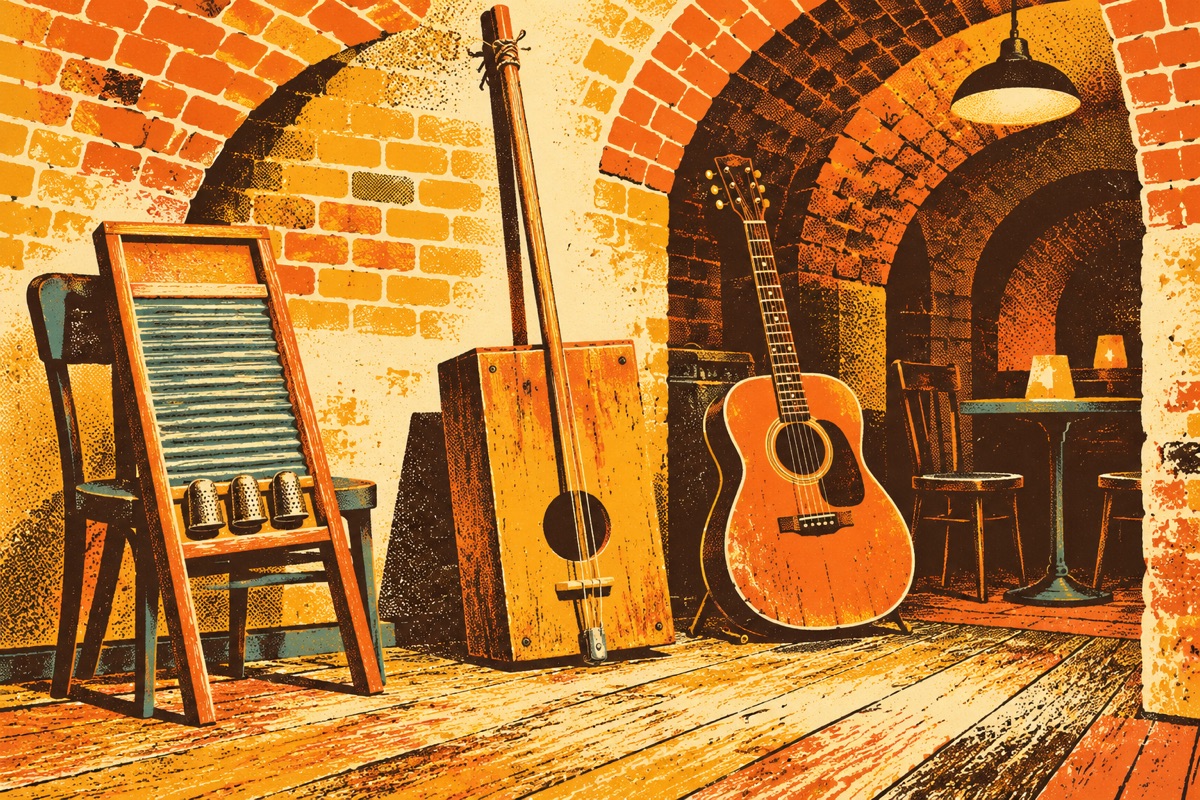
In Britain in the 1950s, skiffle was played on simple instruments. Because these took no years of practice, it was easy to start a skiffle group of your own. The best-known name in this style was Lonnie Donegan. His repertoire showed young musicians that a little courage and a few chords were enough to get going.
Over time, many skiffle groups switched to the electric guitar and moved on to rock'n'roll, from which beat later emerged. Skiffle was thus first a school of playing together and only afterward the starting point for a new style. That is why it belongs in any answer to the question of what beat is.
Beat in Liverpool
In Liverpool, beat music grew into a scene of its own. The Cavern Club, which opened in 1957, played an important part. It began as a jazz club and took its name from a jazz club in Paris. Its story shows the change in the Liverpool scene well: a jazz venue became a meeting place for young guitar bands. Here we keep to these documented facts.
The scene also had a paper of its own: Mersey Beat was founded in Liverpool in 1961 by Bill Harry. Where the name of the style exactly comes from has not been settled, so no single origin of the term can be named.
Features of the Style: What Beat Music Sounds Like
The typical lineup was two guitars, bass and drums, often topped with multi-part vocals. This produced a dense, rhythmic sound. Each instrument had a clear job, while the layered voices gave the songs extra character.
The songs were short and rhythmic, and their harmony was simple. An easy-to-remember chorus let the audience sing along. This plainness traced back to the experience with skiffle and combined with the electric sound of rock'n'roll. That very mixture best explains what beat is.
The British Invasion and Beat in Germany
In 1964, British groups began to score hits in the United States, a phenomenon known as the British Invasion. That is how beat music born in the clubs of Liverpool reached listeners in the US as well.
Beat also came to Germany, where bands of its own sprang up. Its spread shows that beat music did not stay confined to the British Isles.
The answer to what beat is has several parts: skiffle as a school of playing together, the clubs of Liverpool, the simple song form and the road onto the American and German markets. Together they make up a full picture of what beat music was.